Mastering Control Flow and Decision Making in Java

I am Samraj, a motivated fresher with a strong background in Computer Science. I excel in Java programming and have a keen interest in open-source projects. With hands-on experience in Java technologies, I write clean and efficient code. I actively contribute to open-source projects, showcasing my commitment to collaboration and community. My passion for learning and expertise in Java make me an asset for organizations seeking innovative solutions in the open-source space.
Introduction: Control flow and decision-making are fundamental concepts in Java programming. They allow developers to dictate the flow of their programs and make decisions based on certain conditions. In this blog post, we will explore the various control flow and decision-making mechanisms available in Java, understand their syntax, and discuss their practical applications.
Conditional Statements: Conditional statements in Java enable us to execute different blocks of code based on certain conditions. The most commonly used conditional statements are:
if statement: Learn how to use the if statement to execute a block of code if a condition is true, and optionally provide an alternative block using else.
switch statement: Understand how to use the switch statement to evaluate an expression and execute different blocks of code based on the matched case.
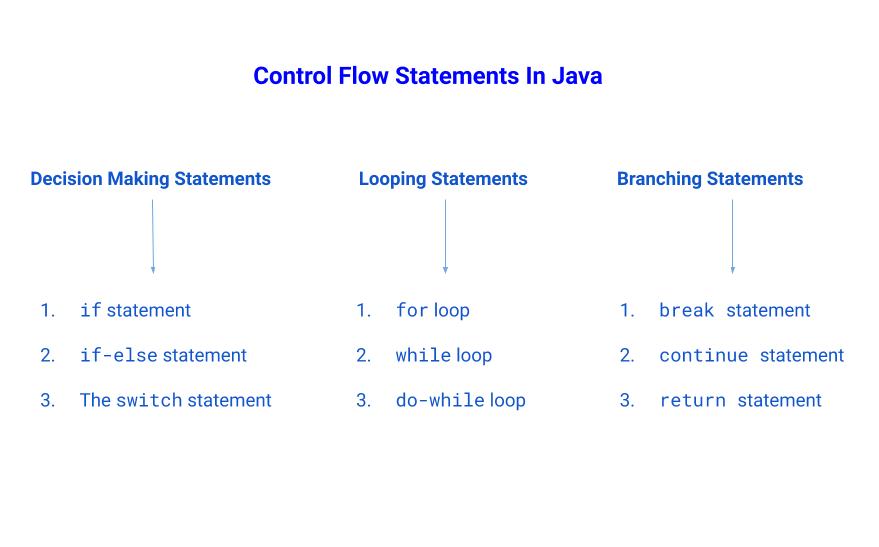
Looping Statements: Looping statements in Java allow us to execute a block of code repeatedly until a specific condition is met or for a fixed number of times. The key looping statements are:
while loop: Discover how to use the while loop to repeatedly execute a block of code as long as a condition remains true.
do-while loop: Learn about the do-while loop, which guarantees the execution of the loop block at least once before checking the condition.
for loop: Explore the for loop, a versatile looping construct that provides a compact way to iterate over a range of values.
Branching Statements: Java provides branching statements that allow us to alter the normal flow of control within a loop or switch statement. The commonly used branching statements are:
break statement: Understand how to use the break statement to exit from a loop or switch statement.
continue statement: Learn about the continue statement, which allows you to skip the current iteration and move to the next iteration of a loop.
return statement: Explore how the return statement can be used to terminate the execution of a method and return a value to the calling code.
Ternary Operator: The ternary operator in Java provides a concise way to make decisions and assign values based on a condition. Learn how to use the ternary operator to simplify code and improve readability.
Practical Examples: Provide practical examples that showcase the effective use of control flow and decision-making mechanisms in real-world scenarios. For instance, demonstrate how to implement a simple calculator or a program that determines whether a year is a leap year or not.
Conclusion: Control flow and decision making are essential concepts in Java programming, allowing developers to create dynamic and responsive applications. By understanding the syntax and practical applications of conditional statements, looping statements, branching statements, and the ternary operator, you can gain better control over the flow of your Java programs. Mastering these concepts will empower you to write more efficient and flexible code.
Remember to practice implementing these concepts in your own Java projects to reinforce your understanding and enhance your programming skills. Happy coding!


